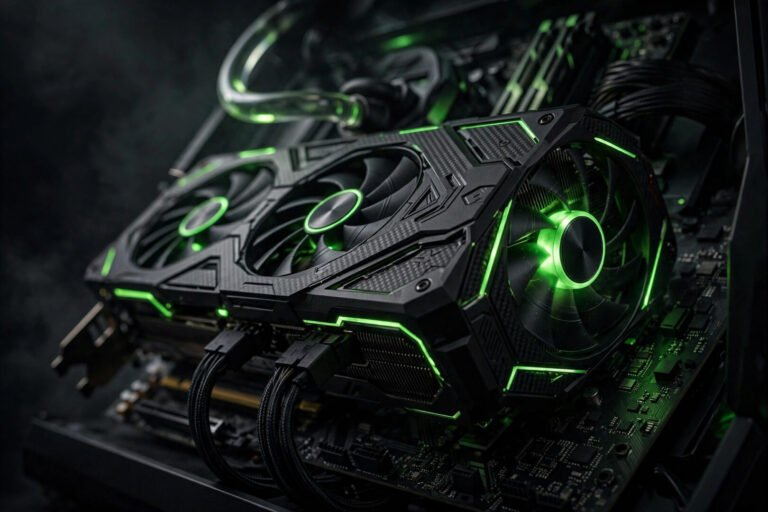

Microsoft Maia 300: 288GB HBM4 AI Chip Explained
Microsoft Maia 300: Everything About the New 288GB AI Chip
Microsoft just made its biggest bet yet on its own silicon. On October 12, 2026, the company unveiled the Microsoft Maia 300, its third-generation custom AI accelerator, and said it will soon become the primary system running AI inference for products like Copilot. If the numbers hold up, it is a direct challenge to Nvidia’s grip on the data center.
The headline specs are hard to ignore: 288GB of HBM4 memory, up to 13.8 PFLOPS of FP4 compute, and a claimed 40 percent improvement in tokens per megawatt over leading GPU-based systems. Here is what the Maia 300 actually is, how it compares to what came before, and what it means for the AI industry.
What is the Microsoft Maia 300?
The Maia 300 is Microsoft’s custom-designed AI inference accelerator, built specifically for the workloads behind its cloud AI services. Unlike Nvidia’s general-purpose GPUs, which handle both training and inference, the Maia 300 is inference-first: it is optimized for running AI models that are already trained, serving responses to chatbots, coding assistants, and AI agents.
This is the third chip in the Maia family. The original Maia 100 arrived in 2023, followed by the Maia 200 earlier this year. Microsoft already uses these chips internally to support products including Microsoft Copilot and GitHub Copilot, and the company says the Maia 300 will take over as the primary inference system as deployments scale up.
Maia 300 specs at a glance
The numbers Microsoft shared paint a picture of a chip built for memory-hungry modern AI:
- Compute performance: up to 13.8 PFLOPS at FP4 precision, 6.9 PFLOPS at FP8
- Memory: 288GB of HBM4 across eight stacks
- Memory bandwidth: 18 TB/s peak, at 9 Gb/s per pin
- Power: 950W thermal design power per accelerator
- Architecture: multi-chiplet design, compute chiplets on TSMC’s N2P (2nm) process
- Networking: two-tier Ethernet with a custom AI transport, 3.2 TB/s bidirectional scale-up bandwidth
- Rack configuration: 96 accelerators, 27.6TB of HBM, around 167kW of power
For comparison, the Maia 200 had 216GB of HBM3E memory with 7 TB/s of bandwidth and a 750W power rating. The jump to HBM4 and 2nm silicon gives the Maia 300 a major step up in both capacity and speed, which matters for long-context reasoning models and multi-step AI agents.
Why Microsoft is building its own AI chips
The short answer is money and control. Microsoft spends billions on Nvidia GPUs to power Azure’s AI services, and every dollar saved on hardware flows straight to the bottom line. Custom silicon lets Microsoft tune the hardware exactly to its workloads, cut out the middleman’s margin, and reduce its dependence on a single supplier.
Microsoft is not alone in this strategy. OpenAI recently debuted its own in-house silicon, and Google has been building TPUs for years. The big cloud providers have all realized that AI infrastructure is too important, and too expensive, to rent entirely from someone else.
There is also a supply angle. With AI demand straining global chip supply chains, owning the design means Microsoft can lock in manufacturing capacity at TSMC on its own terms. According to Reuters, the company may deploy more than one million Maia chips in 2027, which would make this one of the largest custom-silicon rollouts in history.
How Maia 300 compares to Nvidia GPUs
Microsoft’s boldest claim is efficiency: 40 percent more tokens per megawatt than leading GPU-based systems, plus up to seven times the rack-scale token throughput of the Maia 200. In plain terms, Microsoft says the chip can serve more AI responses per unit of electricity, which is the metric that matters most to data center operators.
One important caveat: these are vendor claims. Microsoft has not identified the specific GPU baseline for the 40 percent comparison, so independent testing will be needed before treating the figure as a general result. Still, the architectural direction is clear: Microsoft is measuring success at the rack level, not the chip level, optimizing for total AI output per watt.
This does not mean Nvidia is in trouble overnight. Nvidia’s GPUs remain the default for AI training and for most cloud customers, and its software ecosystem is deeply entrenched. The Maia 300 is aimed at Microsoft’s own inference workloads first, not at the open market. But every inference request served on a Maia chip is one that does not need an Nvidia GPU.
What it means for Azure users and developers
For most people, the Maia 300 will be invisible – it lives in Microsoft’s data centers, not on store shelves. But the effects could still reach you:
Lower costs: cheaper inference hardware could eventually translate into lower prices for Azure AI services.
Faster features: tighter integration between Microsoft’s models and its own silicon could speed up rollouts for Copilot and other AI products.
Better efficiency: more AI output per megawatt is good news for energy-hungry data centers and the grids that power them.
When will Maia 300 launch?
Microsoft says production deployments will begin in 2027, with the Maia family scaling to multi-gigawatt levels as the company’s primary inference system. That timeline gives Microsoft roughly a year to finish validation and ramp up manufacturing with TSMC.
The real test will come when independent benchmarks arrive. Until then, the Maia 300 stands as the clearest signal yet that the AI chip wars have entered a new phase, one where the biggest customers build their own hardware.
FAQs
What is the Microsoft Maia 300?
It is Microsoft’s third-generation custom AI accelerator, designed for AI inference in its own data centers. It features 288GB of HBM4 memory, 18 TB/s of bandwidth, and a multi-chiplet design built on TSMC’s 2nm process.
When will the Maia 300 be available?
Microsoft plans to begin production deployments in 2027, scaling to multi-gigawatt levels as the primary inference system for its own products and services.
Will Maia 300 replace Nvidia GPUs?
Not entirely. It is aimed at Microsoft’s own inference workloads, not the open market. But it reduces Microsoft’s dependence on Nvidia hardware for serving AI features like Copilot.
How does Maia 300 compare to Maia 200?
The Maia 300 jumps from 216GB of HBM3E to 288GB of HBM4, from 7 TB/s to 18 TB/s of bandwidth, and Microsoft claims up to seven times the rack-scale token throughput.
The bottom line
The Microsoft Maia 300 is more than a spec sheet. It is a statement of intent: the era when big tech companies simply bought whatever Nvidia sold is ending. With 288GB of HBM4 memory, 2nm silicon, and a 2027 deployment target, Microsoft is betting that custom chips are the key to cheaper, faster AI. Whether the 40 percent efficiency claim survives independent testing is the question to watch.