Fiverr Pricing for Content Writing Gigs
Understanding the nuances of fiverr pricing for content writing gigs is essential for freelancers aiming to transition from hobbyist status to a sustainable digital career. Setting your rates too low attracts high-maintenance clients, while setting them too high without a proven track record can leave your inbox empty. By evaluating market standards and optimizing your service tiers, you can position your profile for long-term growth.
This article breaks down the financial mechanics of the platform, offering you a clear path to professional success and higher earnings. Read on to discover how to align your professional value with the current demands of the global freelance marketplace.
The Baseline Pricing Structure
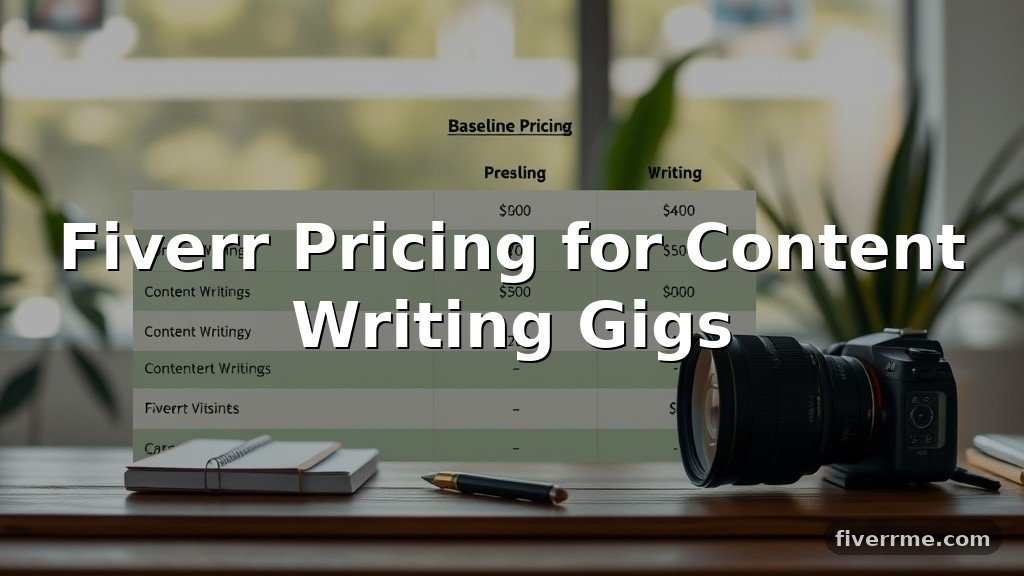
For most beginners, the entry-level price for a standard blog post or article on the platform is $5 to $15. While this may seem low, it serves as an initial mechanism to gather reviews and build social proof. Once you have secured at least 10 to 20 five-star reviews, you should immediately shift your strategy to reflect a more professional standard.
Most intermediate writers on the platform currently charge between $0.05 and $0.10 per word. This means a 1,000-word article should realistically be priced between $50 and $100.
If you are just starting, do not feel pressured to compete with the absolute lowest prices on the site. Those users are often operating on a high-volume, low-margin business model that is difficult to sustain long-term. Instead, focus on providing high-quality, SEO-optimized content that justifies a slightly higher starting price than the absolute bottom.
Your goal is to reach the “Level One” seller status as quickly as possible. This status unlocks additional features, such as the ability to create more custom offers and expand your service tiers.
Factors Influencing Your Rates
Your specific niche plays a massive role in how much you can charge for your work. Technical writing, medical content, and legal articles command significantly higher rates than general lifestyle or travel blogging.
For instance, a writer specializing in blockchain or fintech can often charge $0.20 to $0.30 per word due to the specialized knowledge required. Generalist writers, by contrast, often find themselves stuck in the lower pricing tiers because the competition is significantly higher.
Experience level and portfolio strength are the next biggest variables in your pricing equation. If you have been published in major industry journals or have a track record of ranking content on the first page of Google, you have leverage.
You should clearly display these credentials in your gig description and gallery images. Clients are willing to pay a premium when they can see concrete evidence that your work leads to tangible results, such as increased traffic or higher conversion rates.
Utilizing Fiverr’s Three-Tier Pricing Model
Fiverr provides a mandatory three-tier structure for most writing gigs, which allows you to segment your services effectively. You should name these tiers clearly, such as “Basic,” “Standard,” and “Premium,” to avoid confusing potential buyers. The Basic tier should cover the absolute minimum, like a 500-word blog post with no research.
The Standard tier is usually the most popular, often offering 1,000 words with basic keyword research. The Premium tier should be your high-value offering, including 2,000+ words, deep research, and meta-data optimization.
This tiered approach is a powerful psychological tool that guides the buyer toward the middle option. By making the Premium tier look like a significant value-add for a relatively small price increase, you can raise your average order value.
Many top-rated writers report that over 60% of their revenue comes from these mid-range and high-end packages. Do not make the mistake of keeping your prices uniform across all tiers; the gap should be wide enough to reward the client for choosing the more expensive option.
Comparison of Typical Pricing Tiers
The following table provides a breakdown of how professional writers typically organize their service packages to maximize income while maintaining a steady flow of orders.
| Tier Name | Typical Word Count | Estimated Price Range | Key Value Proposition |
|---|---|---|---|
| Basic | 300 – 500 words | $15 – $30 | Quick turn-around, standard SEO |
| Standard | 800 – 1,200 words | $50 – $120 | Deep research, primary keyword focus |
| Premium | 1,500 – 2,500 words | $150 – $300+ | Comprehensive guide, competitor analysis |
The Role of Fast Delivery Fees
One of the most effective ways to boost your income is by offering “Extra Fast Delivery” as an add-on service. Many clients reach out to content writers because they have a sudden deadline and need high-quality work immediately.
You can charge an additional 20% to 50% of your base price for a 24-hour turnaround time. This provides value to the client while compensating you for the inconvenience of shifting your schedule.
Be careful not to overpromise on these fast turnarounds, especially when you are busy. If you miss a deadline, the negative impact on your seller rating will cost you far more than the extra fee you earned.
Only offer expedited services when you know you have the bandwidth to deliver high-quality work without rushing. Use this feature as a strategic lever during slow periods to attract clients who are willing to pay for speed.
Upselling Through Gig Extras
Gig extras are the “hidden” revenue stream that many writers ignore, yet they are vital for increasing your total earnings per order. You should offer specific services that complement your writing, such as image sourcing, social media post creation, or deep-link insertion.
For example, charging an extra $10 to $20 for finding and formatting two royalty-free images is a standard practice. These small additions add up quickly and make your gig more attractive to busy business owners.
Consider offering “Additional Words” as a flexible extra for clients who need a bit more than your standard packages. If a client needs 1,300 words but your standard gig is capped at 1,000, they can simply add the extra quantity to their order.
This keeps the transaction within the platform and ensures you are paid for every word you write. Always keep your extras clearly defined so there is never any ambiguity about what the buyer is paying for.
The Impact of Seller Levels
Fiverr operates on a system of levels that directly correlates with your ability to command higher prices. As you progress from a New Seller to Level One, Level Two, and eventually Top Rated, your profile gains more visibility.
Higher levels indicate to potential clients that you are a proven, reliable partner who understands the platform’s requirements. This trust factor allows you to gradually increase your base rates without losing your steady stream of orders.
Reaching Top Rated status is a significant milestone that often allows you to move into the top 10% of earners on the site. At this stage, you should not be competing on price at all; you should be competing on quality and brand authority.
Many writers at this level stop using the base $5 or $10 entry points entirely. They use their high search ranking to attract enterprise-level clients who are looking for long-term content partnerships rather than one-off articles.
Handling Custom Offers
Custom offers are the backbone of high-end freelance writing on the platform. When a client contacts you with a project that doesn’t fit your pre-set packages, you should always create a custom quote.
This allows you to price the project based on its actual complexity rather than a standardized template. For complex, multi-part projects, you can break the payments into milestones to ensure consistent cash flow.
When drafting a custom offer, always include a clear scope of work document. Detail exactly how many revisions are included, what the research process entails, and the final word count expectation.
This level of professionalism prevents “scope creep,” where a client asks for extra work without paying for it. By being explicit in your custom offers, you establish yourself as a serious business professional who values their time.
Strategies for Raising Your Prices
It is common to feel nervous when raising your prices, but it is a necessary step for any successful freelancer. The best way to do this is incrementally rather than all at once.
For example, if you are charging $50 for a 1,000-word article, increase it to $60 for a month, then $75, and so on. If your conversion rate remains stable, you know the market is willing to pay the higher amount.
If you find that your order volume drops significantly after a price increase, you can always revert or offer a limited-time discount to loyal clients. You can also rebrand your gig to include more value, such as adding a free plagiarism report or a professional content brief.
Providing extra value makes the price increase feel justified to the client. Remember that you are in business to make a profit, not just to stay busy.
Common Pitfalls to Avoid
Many writers fall into the trap of “price anchoring” at the bottom of the market and struggling to escape. Once you have a steady stream of work, you must prune your low-paying clients to make room for those who pay better rates.
If you spend 10 hours a week on $5 gigs, you are essentially preventing yourself from taking on a $200 project. Always analyze your “hourly rate” to see if your current pricing strategy is actually worth your time.
Another major mistake is failing to account for the platform’s service fees. Fiverr takes a 20% commission from every sale you make. You must factor this into your pricing so that your “take-home” pay remains profitable.
If you need to earn $40 for an article, you should be charging at least $50 to account for the platform’s cut. Ignoring these fees is a quick way to find yourself underpaid despite appearing “busy” on the platform.
Essential Tips for Success
* Optimize your profile: Use high-quality professional photos and a clear, benefit-driven bio.
* Focus on SEO: Research keywords that your target audience uses to find writers and include them in your gig title and description.
* Build a portfolio: Even if you are new, include samples of your best work in your gig gallery.
* Communicate effectively: Respond to messages quickly and professionally to improve your response rate.
* Gather testimonials: Ask every satisfied client to leave a review; it is the most important factor for long-term growth.
* Use the official Fiverr guidelines to ensure you never violate platform terms of service.
Frequently Asked Questions
Is it possible to start with high prices on Fiverr?
While you can set your prices wherever you like, starting with high prices without any reviews is extremely difficult. Most buyers on the platform prioritize social proof and historical performance when selecting a writer. It is usually more effective to start at a competitive rate, gather 10-15 five-star reviews, and then scale your pricing upward as your reputation grows.
How often should I adjust my rates?
You should review your pricing at least once every three months. If your current gig is consistently fully booked or you are receiving inquiries faster than you can handle, it is a clear signal that you should raise your rates. A good rule of thumb is to increase your prices by 10-15% whenever you reach a new seller level or notice a significant increase in demand.
What if a client complains about my pricing?
It is helpful to view price complaints as a sign that you are targeting the wrong demographic. Professional clients who value high-quality content generally understand that expertise comes at a cost. If someone asks for a significant discount, politely explain the value and research that goes into your process. If they persist, it is usually better to walk away and focus on clients who respect your professional standards.
Do I need to pay for advertising to get orders?
Fiverr offers a “Promoted Gigs” feature, but it should only be used once you already have a high conversion rate and a strong portfolio of reviews. Advertising a gig with no reviews is essentially burning money because the landing page won’t convert traffic. Focus on organic optimization first, and only consider paid promotion once your gig is already performing well and you have room to scale.
How do I handle the 20% platform fee?
You should treat the 20% fee as a cost of doing business, similar to taxes or software subscriptions. Always calculate your desired take-home pay first, then divide that number by 0.8 to determine the price you need to set on the platform. For example, if you want $80 in your pocket, you should set your price at $100. This ensures your net income remains consistent regardless of the platform’s commission structure.
Conclusion
Mastering fiverr pricing for content writing gigs is a journey of constant iteration and professional refinement. By starting with a competitive baseline, carefully scaling your rates based on your growing reputation, and utilizing the platform’s built-in tools like tiers and extras, you can build a highly profitable freelance business. Success on the platform is rarely about luck; it is about providing consistent value that helps your clients achieve their own business goals.
Keep your focus on delivering high-quality, results-oriented content, and the financial rewards will follow. Start by auditing your current packages today, adjust your pricing to reflect your true expertise, and take the next step toward a sustainable and lucrative freelance career.